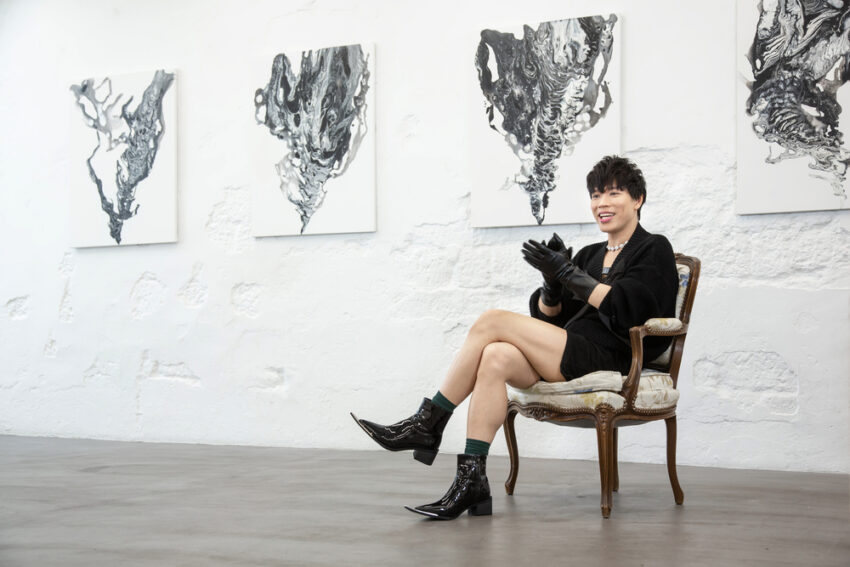
Wallace Woo thinks in geological time, and it shows. His canvases carry the density of strata formed over millennia, each layer a negotiation between pigment and pressure, between what is visible and what lies beneath. Born from the collision of Hong Kong’s relentless compression and Paris’s slow, graceful erosion, his practice is as much philosophy as it is painting. We asked him everything.
“Geological abstractionism” is a manifesto, a mood, or something you’re still defining as you go?
If someone asks me whether “Geological Abstractionism” is a manifesto, an emotion, or a process I am still exploring, I would say it is all three, and it is the only outlet for my current state of being.
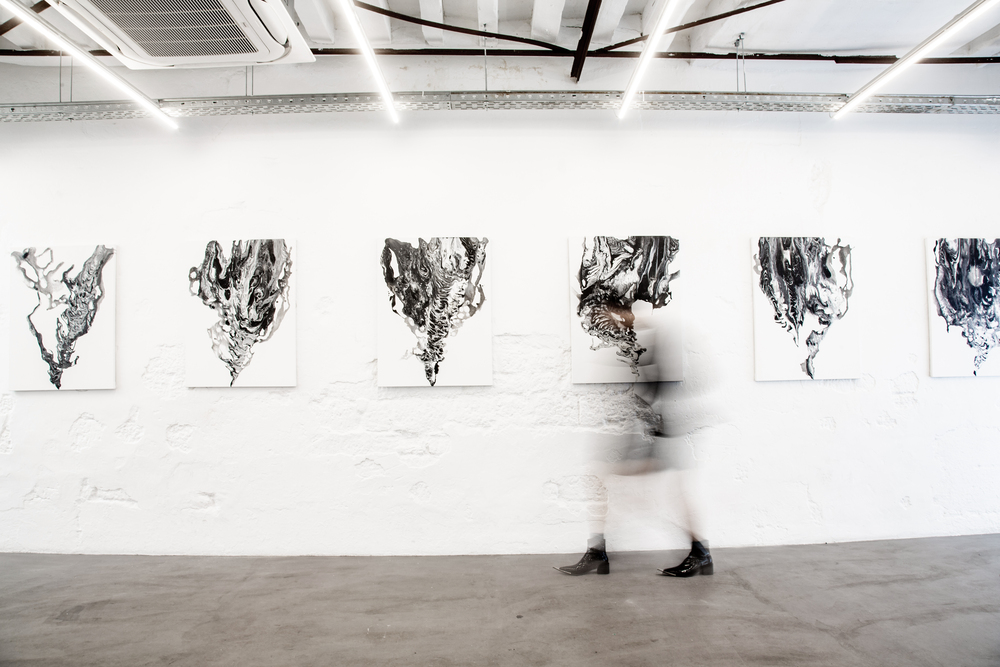
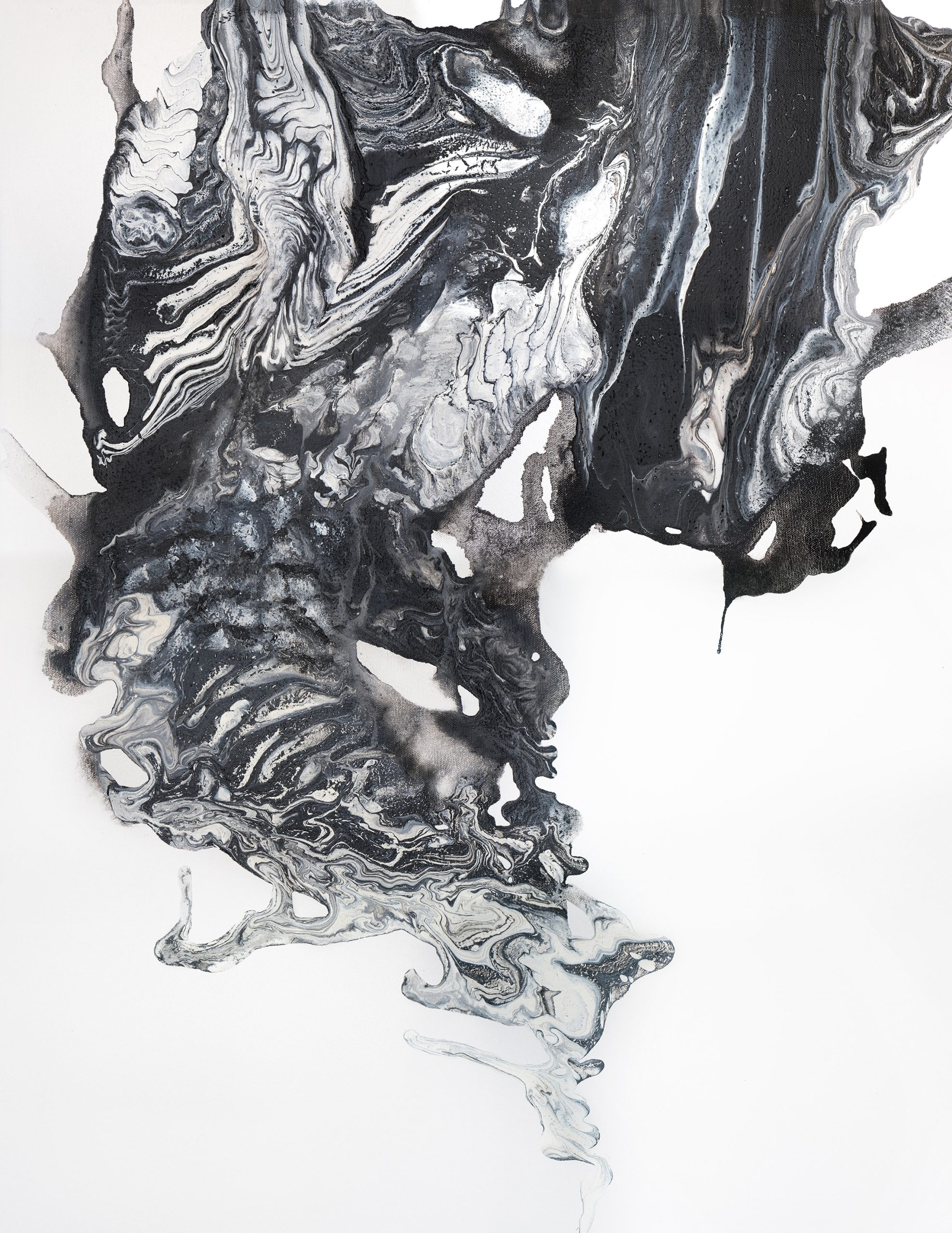
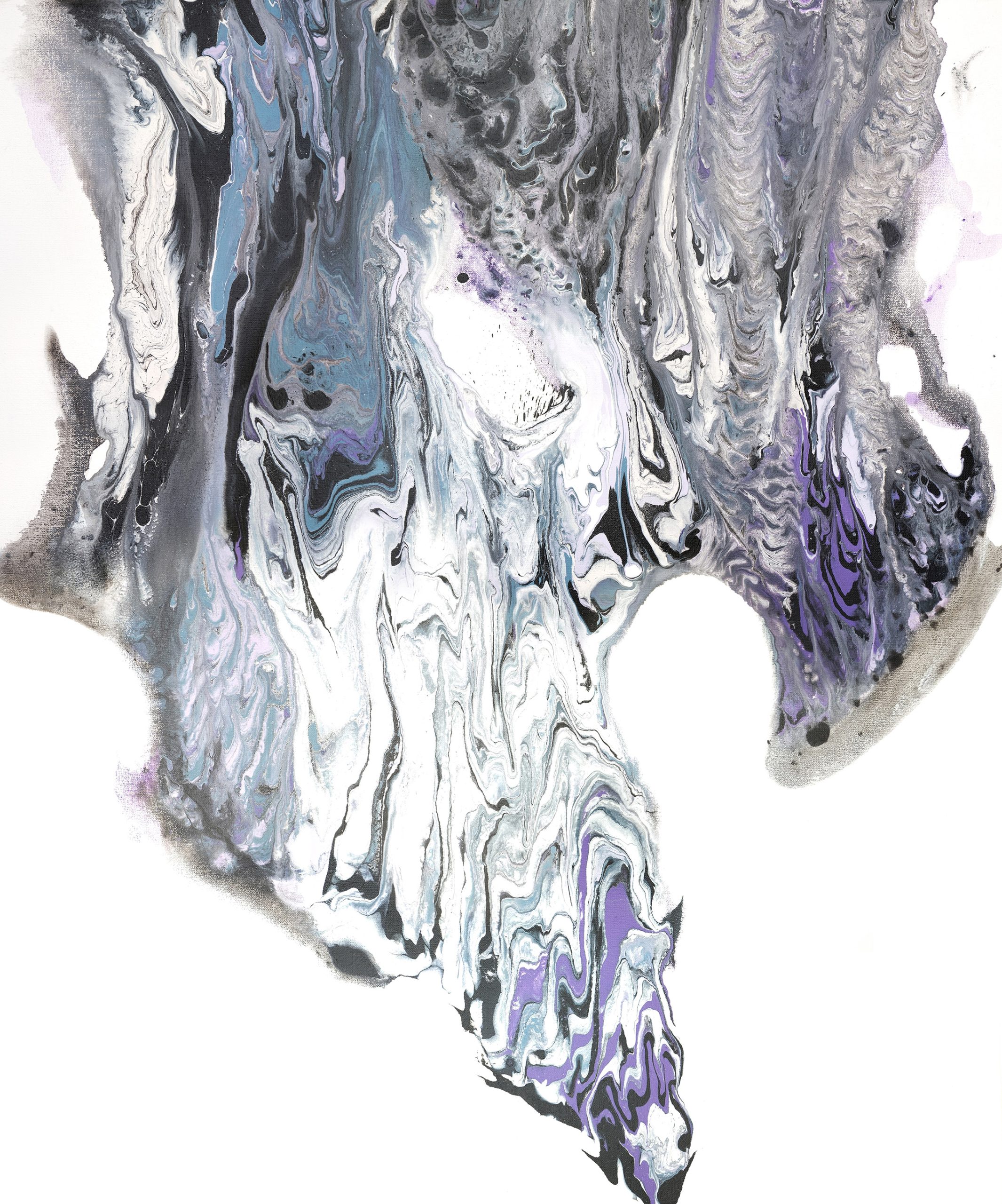
Many people ask me how to define this movement. I usually start with the technique: it is a method of transplanting the physical laws of geological evolution, layering, compression, fracturing, and solidification, onto the canvas.
Every texture you see is a “geological experiment” between me and the pigment. Yet that is merely the surface. Underpinning these techniques is what I call “stalactite aesthetics,” a vast worldview that is not only my manifesto, my statement as an artist, but also a survival technology for navigating this world. In the past, I believed that life was like a river, chasing fleeting moments of inspiration and rapid resonance.
But as life layers upon itself, I came to realize that the true nature of life is actually a mountain. It is not accomplished through flow, but through the heavy pressure and sedimentation of time. When I learned to see the world as it is, and to let go of my attachment to “being understood,” art ceased to be an emotional release and became a deep practice of controlling and releasing emotion.
In this dimension, “Geological Abstractionism” becomes extraordinarily vast. It transcends any single art form, encompassing the emptiness of Zen, the dialectics of philosophy, and even the laws of material necessity in physics. I distill these grand propositions into the purest textures and structures, presented on the canvas. I do not seek to make every metaphor immediately readable; I simply hope that, in that silent texture, viewers might perceive a certain “weight of the real.”
Once I completed the architecture of this system, once that mountain of mine stood firm on the canvas, what I needed to explore as a creator was essentially done. From that point on, this movement is for the world. I do not intend to confine it, nor do I wish to define it. What I find most captivating about any artistic movement is its openness; it should be like a natural stratum, offering viewers infinite space to think and to dig.
Every soul who stands before a canvas, if they can recognize in my work the answers they individually seek, whether comfort for their solitude or courage for their survival, that is where its true value lies.
This has become a fascinating process for me, because I no longer create to “prove myself.” Instead, I observe, with an almost detached calm, how human beings awaken through this sedimentation. Geology is honest; no matter how trends shift on the surface, no matter how social metrics change, the essence of this mountain remains unchanged. I simply use a minimalist approach to present, as truthfully as I can, the possibility of this awakening before people’s eyes.
So, if you must ask whether it is still being explored, my answer is: the exploration of technique has reached a resting point, but the cultivation of this awakening has only just begun. Let us see what time will carve out of all this.
Hong Kong and Paris are two cities with very different relationships to beauty. Which one shaped your eye more, and in what way?
These two cities have not influenced my aesthetic sensibility in a competitive, “either-or” way. Rather, they constitute a kind of “geological compression” between two extreme forces in my creative practice.
Hong Kong is a city defined by “vertical compression.” Its high density, relentless pace, the frantic stacking of concrete and steel, and that suffocating sense of survival within narrow confines have directly shaped my sensitivity to “thickness” and “structure.” Standing on the streets of Hong Kong, you feel the tension of space compressed to its limit, a man-made “geological compression.”
This environment taught me that beauty does not have to be light; it can be heavy, crowded, even resistant. The layered pigments and breathless textures in my work are, in fact, an imprint of survival left on me by this city.
Paris, on the other hand, offered me another dimension: “the sedimentation of time.” If Hong Kong is vertical compression, then Paris is horizontal accumulation. The aesthetic of this city lies in its allowance for things to erode, to flake, and to coexist gracefully with history over time.
Here, I learned to observe the way pigment “evolves naturally” on the canvas, rather than merely being applied by human hands. That reverence for the traces of age shifted my aesthetic from mere “resistance” toward a deeper awe for the “essence of existence.”
If Hong Kong gave me the “compression and pressure” within Geological Abstractionism, then Paris gave me my understanding of “time and eternity.” Their convergence constitutes my “stalactite aesthetics”: accumulating under Hong Kong’s pressure, crystallizing within Paris’s time. What I continuously experiment with in my work is how to translate these two radically different urban rhythms into a timeless visual syntax.
I am not inclined to say which city has influenced me more, because the essence of my art is a kind of “multiversal perspective” I am constantly shuttling between the two. When I am in Hong Kong, I long for the slower breath of Paris; when I am in Paris, I inevitably bring with me that Hong Kong tenacity for digging out truth at the limits. It is precisely these two contradictory forces that constitute the most authentic “geological structure” within my work.
Your work deals with deep time – geological, almost prehistoric scales. Does that change how you experience everyday life, or do you compartmentalize?
Many people wonder whether immersing myself in such vast, geological timescales creates a disconnect from everyday reality. For me, the two are not separate at all; they are completely fused.
The geological scale has not made me detached; on the contrary, it has given me a kind of “calm tenderness” toward daily life. When you grow accustomed to thinking in terms of tens of thousands of years, those petty anxieties, disputes, and minor frustrations of the moment suddenly feel feather-light. This perspective has taught me how to “sediment” so as not to be trapped by the passing instant.
I believe art is, at its core, a “transformation” of reality. When I work on the canvas with those layered, fractured textures that resemble strata, it is essentially the same attitude I bring to life and emotion. The quiet moments I spend alone in the studio, contemplating, sipping wine, are intertwined in my senses with my reflections on the grand forces of nature. The pigments I layer on the canvas follow the same logic as how I handle mundane matters in daily life: both are about learning to coexist with “flux.”
This perspective actually makes me cherish the present even more. Having witnessed the vast vicissitudes of geological time, I know more clearly what is truly worth holding onto. This way of thinking does not make me escape from reality; it anchors me more firmly in the here and now. Even savoring a dish or observing a ray of light becomes dimensional and profound, enriched by the thickness of time.
For me, geology is not an excuse to withdraw from life; it is a reason to find a lasting stillness amid the chaos of the world. I do not need to separate creation from living, because everything I cultivate, in essence, is an experience of the weight of time.
If you had to curate a dinner – the guests, the food, the room, the lighting – what would it look like, and would any of your work be on the walls?
If I were to host a dinner party, it would be a ritual of “time, geology, and sensory sedimentation.”
I would choose a natural stone cave filled with bamboo as the venue, a space caught between the primal and the elegant. Dimly lit, with the fresh green scent of bamboo slowly diffusing through the cool, ancient air of the rock, it would feel like a hidden paradise secluded from the mundane world.
My works would naturally hang on the walls. Not merely for display, but because this is precisely the state in which I create: I am accustomed to sipping red wine in the studio while repeatedly examining the canvas. I want my guests to share that same experience, to gaze closely at those geological textures, enveloped by the warmth of wine and the fragrance of bamboo.
As for the guests, I would invite them to arrive in elegant formal wear, creating a tension between civilization and nature within that primitive setting. For the main course, I would choose French roast duck, with the highlight being its crispy skin layered with black sea salt.
The savory crispness of the duck skin echoes the textured layers and fissures in my work, while the depth and richness of the red wine resonate with the sedimented time and emotion embedded in the canvases.
The lighting throughout the evening would be carefully crafted, never too bright, but leaving a subtle, flowing interplay of light and shadow between the stone walls and the paintings, as if deep underground, where only the truest structures are caught by the light.
There would be no tedious social formalities, only music, fine wine, the aroma of roast duck, and the frozen time on the walls. Guests in their formal attire would move among bamboo shadows and stone surfaces. In that moment, we would not simply be dining; we would be undergoing a shared sedimentation. This, to me, is the most perfect connection between art, life, and humanity.
Is there a designer, an architect, or a fashion house whose aesthetic sensibility genuinely excites you right now?
In contemporary design, I have two aesthetic favorites, each representing a force I most long to capture, one in fashion and the other in architecture.
The first is Schiaparelli’s haute couture. What fascinates me most about designer Daniel Roseberry is his ability to precisely embed boundless fantasy into various biological forms. His designs are not merely clothing; they function like an “exoskeleton,” seamlessly merging the human body with the raw textures of nature, radiating an extraordinarily vibrant life force.
That tension between the surreal and the figurative resonates deeply with what I strive to create on the canvas, excavating the truest essence of life from within the absurd.
In architecture, I am currently most captivated by Kvorning Design’s Salmon Eye in Norway, a floating ellipsoid clad in thousands of stainless-steel scales, hovering like a living creature on the fjord. I have never set foot inside, but even through images and documentation, it speaks to me as a quiet metaphor for life: from the outside, it appears alien, almost unworldly; inside, it is warm, organic, entirely human.
That tension, between how the world sees us and what we truly are inside, is something I recognize deeply. It reminds me that we can appear formidable and strange to others, while holding a quiet tenderness within. That interplay of contrast and atmosphere is precisely what excites me, not just in architecture, but in the way we build our own lives.
The convergence of these two influences is, in fact, my own aesthetic positioning for my work: it must carry the impact of Schiaparelli, challenge the limits of the senses, while also possessing the stable, grounded thickness of Zumthor’s architecture, so that in the moment of gazing, space itself feels as still as frozen time.
This coexistence of “tension” and “sedimentation” is precisely my intuitive judgment of what art should look like at the deepest level of my soul. When I create, I seek this very equilibrium. This is not merely a stylistic choice; it is an instinctive dialectic of artistic language. If I can find that precise intersection between impact and sedimentation, then that, as an artist, is the most complete answer I can offer to the world.
What’s a place, a city, a landscape, a room, that changed the way you see?
If there is one place that fundamentally changed the way I see things, it has to be Iceland.
I make a point of visiting its blue ice caves. They are an extraordinary site for philosophical reflection; it’s a kind of appointment I keep with myself. You return to the same spot a decade later, and the ice before you appears unchanged, but beneath the surface, time has already reshaped its internal structure through countless cycles of melting and re-forming.
This taught me a profound lesson: isn’t life the same? It may not be perfect in every detail, but through endurance and accumulation, it can still be complete. This embrace of imperfection is the very foundation of my artistic practice.
Beyond the ice caves, Iceland’s northern lights also taught me something about the nature of happiness.
Many people regard seeing the aurora as a matter of luck, but I see it more as a choice. Even if two people stand in the same place at the same time, they may not witness the same light show, because it may arrive quietly in the small hours, while most are asleep. Happiness is no different: if you are unwilling to wait, if you do not actively reach for that moment of awakening, it will pass you by.
I will never forget my first encounter with the northern light, walking closely around the frozen lake at Jökulsárlón, watching that emerald glow dance across the sky; the feeling still lingers with me to this day.
I believe that once you have truly and attentively witnessed the northern lights, that experience becomes a resonant energy that stays with you for life. It is not merely light; it is a reminder that happiness never falls from the sky; you have to reach out and seize it yourself. Once you have had that absolute experience of beauty, it transforms into an inner grounding that will accompany you for the rest of your life.
Do you think beauty is something you’re born attuned to, or something you have to learn to see?
If you ask me whether beauty is innate or learned, I often think of a stone picked up casually by the roadside.
The same stone, placed in the corner of a grocery store, might be nothing more than clutter. But if it is set upon a museum plinth, it is instantly endowed with aesthetic weight and artistic value. This tells us that beauty is never a fixed property of an object itself; it is a “perspective that is conferred.”
During my years as a makeup artist, I often said: “There are no ugly people in this world, only those too lazy to face themselves.” That statement still holds true today. Because beauty, in fact, is a practice of awareness, not merely a matter of predestined endowment.
Some may be born with a heightened sensitivity, but without the honing of experience and a deep gaze into life, that sensibility can easily remain superficial. I firmly believe there is no such thing as a “free lunch” in this world.
The universe constantly sets up various thresholds and mechanisms, guiding us to experience, to touch, to deconstruct. When we learn, through these encounters, to precipitate meaning from ordinary moments, that inner radiance that emerges is beauty in its most vital form.
Even the beauty born of nature does not reveal itself without an awakening, and that awakening is an act of conscious awareness.
What we call “learning” is, in fact, the process of decoding these mechanisms. When you stop being lazy, when you stop going through the motions of life, when you begin to look with intention at a stone, at the northern lights, or at the fractures within your own life, you complete the transition from merely “seeing” to truly “understanding.”
Life itself is a process of taking that stone from the grocery store and, through experience and reflection, carving it into the “artwork” displayed in the museum. Beauty is never a destination; it is the trajectory of our continuous resonance with the world throughout our awakening.
What does luxury mean to you, in life, and in art?
To define luxury, we must first peel away the layers carefully wrapped by capitalism.
In my worldview, luxury is a relative dimension. In a famine-stricken corner of Africa, if a child manages to catch Chaoborus edulis and turn it into a ” Nkhungu cake,” that sense of satiety, in that moment, is the ultimate luxury for them.
Meanwhile, on the streets of Paris, when people sit in an expensive Michelin-starred restaurant savoring exquisitely crafted culinary art, that too is called luxury. Though these two scenarios seem worlds apart, to me they both reveal a dialectic of survival and desire: the essence of luxury lies in “scarcity.”
Yet we now live in an era where capitalism has forcibly inflated value. In this context, luxury has been reduced to a price tag, expensive handbags, artworks with staggering auction figures, limited-edition status symbols. But I believe this market-defined luxury is, in fact, extremely cheap.
Why? Because as long as you have enough currency, you can easily buy these so-called ultimate luxuries. When luxury becomes something that can be priced at will, mass-produced, and acquired through money, it loses all spiritual weight. This kind of luxury is merely an illusion woven by the market to sustain supply and demand.
True luxury never depends on money; it depends on “unrepeatable time” and “irreproducible sensory experience.”
In life, true luxury is when you finally let go of your attachment to external labels and begin to truly be with yourself, feeling the breath of every moment. In art, true luxury is the willingness to spend a lifetime refining a single pigment, a single texture, a single promise about the afterlife, even without an audience, even without premium valuation.
The greatest misreading in the contemporary art world is mistaking “high price” for “high nobility.” We live in an age of luxury overload, chasing the illusions handed down by capital, while overlooking what is truly scarce.
I often think of that film about a CEO stranded on a desert island after a plane crash; in that extreme situation, no matter how much wealth and power he possessed in his former life, it all became meaningless. Only the survival instinct mattered. This made me deeply realize that those “luxuries” packaged by capital are actually fragile and cheap.
For me, true luxury is being able to control my own creative rhythm; it is using my work to leave a coordinate for my loved one’s soul across the river of time. When you stop being led by the nose by market definitions, you realize that true luxury is “autonomy”; it resides in every moment of your awakening, in every instance when you can define value and beauty independently, without reliance on external things.
Luxury is not about how much you possess. It is about how much of your own unpriceable soul-weight remains in this clamorous world of capital. As long as life endures, as long as we retain that intuition and creativity, we will always have the chance to define ourselves—and that, to me, is the only asset in this world truly worthy of being called “precious.”
Is there a medium or a discipline completely outside visual art that you think you could have been good at?
I have asked myself countless times: if I gave up creating, what else could I do? I have tried to find answers in other professional fields, but every time I circle back, I always end up at the door of art. Perhaps this suggests that some paths are scripts already written for you by the universe; I keep performing the same role of an artist, yet in every rehearsal, I discover a new version of myself.
But I don’t see this as a limitation; rather, it feels like a curious inevitability. I have always approached the world with a childlike curiosity. Even if it’s not a discipline or medium I am trained in, as long as it sparks even a sliver of interest, I am willing to push open that door like a complete beginner. For me, artistic creation is not merely about what happens on the canvas; it is a “lens through which I explore the world.”
I believe the most precious quality of an artist is that “unfading curiosity.” I don’t like to confine myself by saying, “This is not what I’m good at; that would be far too dull. If I become interested in quantum mechanics tomorrow, I might go and read a thick volume of papers. If I find myself fascinated by the chemical structure of soil, I might start studying geology.
Though I will always return to painting in the end, I believe that those fragments I gather from other fields, those foreign bodies of knowledge that once puzzled and excited me, will eventually transform into pigment and sediment in my work.
So even if this is a script already written for me, I will still explore the world through the eyes of a curious child, and engrave the traces of those explorations, drop by drop, into my creations. This is how I interact with the world; even if I can only play this one role in this lifetime, I intend to play it brilliantly, and I will always keep my passion alive for everything beyond the script.
What would you want someone to feel walking into a room that’s entirely yours, your art, your objects, your choices?
If there were truly a room that contained everything about me, my paintings, my belongings, my choices, I would hope that when you push open the door and step inside, what you feel is not a “display,” but an invitation into my “inner vision.”
I often think that perhaps no one in this world can truly fully understand another person. Even my husband, who has been by my side for years, may not be able to unpack every single thought deep within me, but he has given me the most precious thing of all: unwavering companionship. This made me realize that art, for me, is a bridge built out of the solitude of not being fully understood.
Sometimes, even I don’t clearly know what I am thinking. My mind is like an endless, ceaseless storm. The exhaustion that comes with this “constant thinking” is a fate an artist cannot escape; and that loneliness of “never being fully seen” is a weight I have carried for a long time.
So, if this room could open itself to anyone, I would hope it becomes a space that can share that burden with me. I would hope that visitors do not come seeking a definitive answer, but rather to stand with me in facing that unknown chaos and struggle. This is a peculiar request: I invite you in, not to define me, but to help me carry the weight of being “too awake.”
When you stand before my work, if you can feel even a trace of resonance with me, even for a moment, that, to me, is a kind of redemption. Art, for me, is not only expression; it is also release. I hope that room can make you feel that even when this world sometimes feels exhausting, within these layered textures and choices, you are not alone. We are all here, trying to find, amidst the chaos, a fragment of solace for the soul.
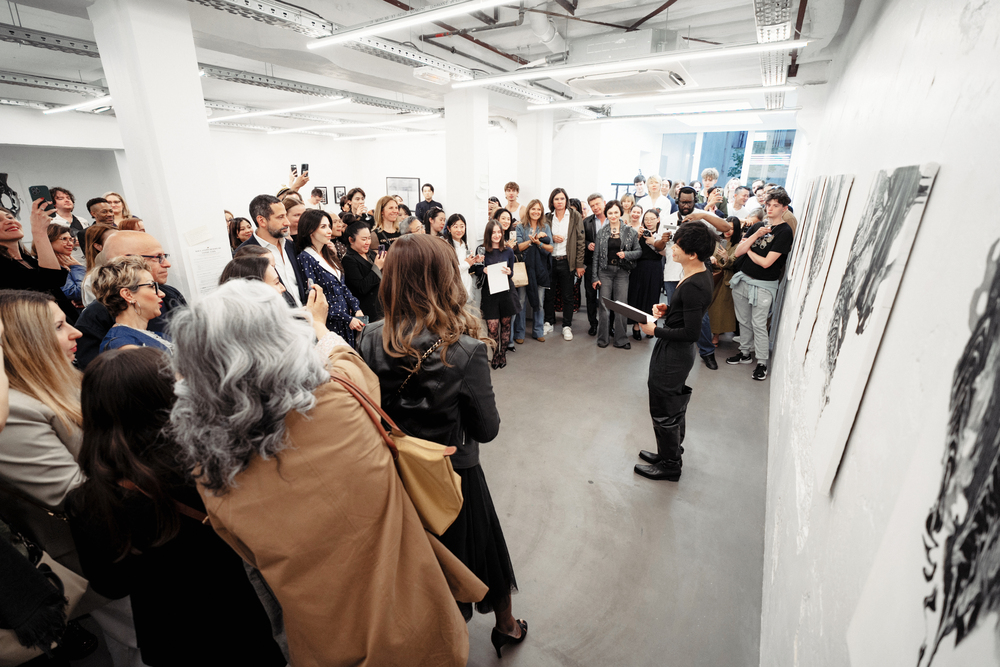
Photographer: Alejandra Gomez / Gallery & Portrait Anis Chehri / Vernissage
More about Wallace Woo on:
Website
Instagram
Youtube