
Set on a wooded hillside above the Puster Valley in South Tyrol, Castel Badia occupies a medieval complex with more than a thousand years of history behind its walls. Known locally as Schloss Sonnenburg, the landmark in San Lorenzo di Sebato reopened in December 2025 as a boutique hotel, following an extensive three-year restoration. The architectural work was led by local studio Null17, with interiors by Milan-based Droulers Architecture in collaboration with designer Marta Ferri. Their approach gives the castle a new hospitality identity while retaining the architectural character and regional traditions embedded in the site.


Founded around 1000 by Count Otwin von Lurngau as a fortified seat of justice, the castle was later transformed into a Benedictine convent by his son, Volkhold. It became the first convent for women in historic Tyrol and remained an important religious and cultural centre for more than seven centuries. After its dissolution in 1785, the building went through several uses, serving as a military hospital and later a poorhouse, before falling into disrepair. Entrepreneur Karl Knötig rescued the complex in the 1960s and converted it into a hotel. Its latest chapter is led by hotelier Aldo Melpignano, in partnership with Kronplatz Holding and the Gasser and Knötig families.

The restoration, carried out in close coordination with heritage authorities and specialist craftspeople, was guided by a decision to retain the building’s accumulated history. Original frescoes, Romanesque vaults and Gothic architectural details have been carefully preserved, including the 11th-century crypt, where fragments of medieval wall paintings remain visible. New elements, such as discreet window frames and concealed lighting, are integrated with restraint, keeping the historic surfaces and structural details at the centre of attention.
Inside, the design draws on the material vocabulary of Alpine homes. Hand-finished plaster, timber panelling, exposed beams and pine flooring establish the main palette, accompanied by earthy colours, velvet upholstery and textured linen. Contemporary furniture shares the rooms with traditional Tyrolean pieces, while local craftsmanship and folk references appear throughout the interiors.


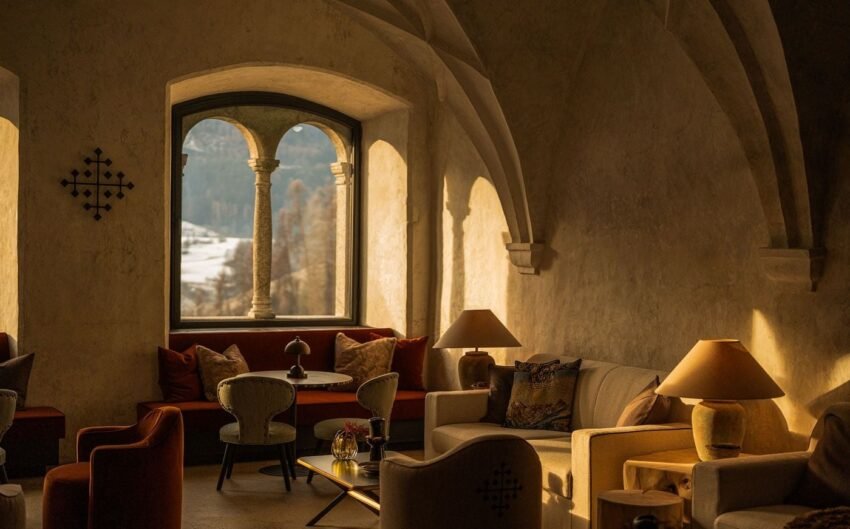
One of the most striking spaces is the former Abbess’s Hall, now reimagined as a lounge. Burnt-orange banquettes, cream sofas and rounded armchairs occupy the room beneath its high ribbed vaults. Elsewhere, antique wooden chests serve as coffee tables, plank-built armchairs bring a rustic note to the seating areas, and embroidered details draw on regional decorative traditions. Deep-set arched windows frame views of the mountains, bringing the surrounding landscape into the castle’s interior life.


The hotel’s 28 rooms and suites have each been designed in response to their individual architectural settings. Some feature softly plastered walls, exposed beams, sisal carpets and wool throws, with furnishings in shades of cream, beige and brown. Others retain a more pronounced Alpine character through timber-clad walls and ceilings, wrought-iron beds and richly textured fabrics. Private balconies, terraces and patios offer views across the courtyard, the neighbouring village or the valley. Bathrooms include details such as freestanding bathtubs, private saunas and hammams, depending on the room. Guests seeking additional privacy can stay in a separate three-storey chalet with its own panoramic terrace.


Dining takes place across several historic rooms, each retaining a distinct atmosphere. The intimate wood-panelled Stube, a traditional Alpine parlour, features a carved timber ceiling and an antique tiled stove decorated with blue-and-white floral motifs. Larger dining rooms are marked by ornate plaster ceilings, solid wooden tables and traditional Tyrolean chairs with carved backs. Upholstered armchairs and built-in timber banquettes, layered with patterned cushions, complete the domestic feel.


Under the direction of chef Alberto Toè, the kitchen works with the ingredients and culinary traditions of South Tyrol. Seasonal menus bring together mountain cheeses, garden vegetables, broths and regional desserts, alongside contemporary readings of local recipes. The hotel’s gourmet restaurant takes a more exploratory route, with a chef’s table and open hearth at its centre. Wild ingredients, slow fermentation and ancestral cooking methods inform a menu that examines Alpine cuisine through a more experimental lens.


Wellbeing is another part of the castle’s new identity, with the subterranean spa drawing inspiration from its monastic history. Botanical preparations and aromatic treatments reference the Benedictine tradition of herbal medicine. Romanesque-vaulted corridors lead to former monastic cells now used as treatment rooms, while an indoor heated pool and relaxation spaces look out towards the valley. Outside, a Finnish sauna and two heated infinity pools open onto the mountain scenery. The grounds contain 17 gardens, including the restored Apothekergarten, inviting guests to explore the estate at a slower pace.

The surrounding Dolomites provide access to skiing, hiking and cycling throughout the year. Cultural destinations nearby include the historic town of Brunico, Zaha Hadid’s Messner Mountain Museum Corones and the LUMEN Museum of Mountain Photography.

Castel Badia also stands as a destination in its own right, an achievement recognised with the Best Design title at the Best Luxury Hotel Awards 2026. The distinction acknowledges the work of Droulers Architecture, whose interiors bring warmth and contemporary detail into the castle’s medieval framework. Its successive identities as fortress, convent and hotel remain visible throughout the building, giving the restoration a sense of continuity grounded in the place itself.


More about Castel Badia online:
Website
Instagram
Photo: (c) Courtesy of Castel Badia